
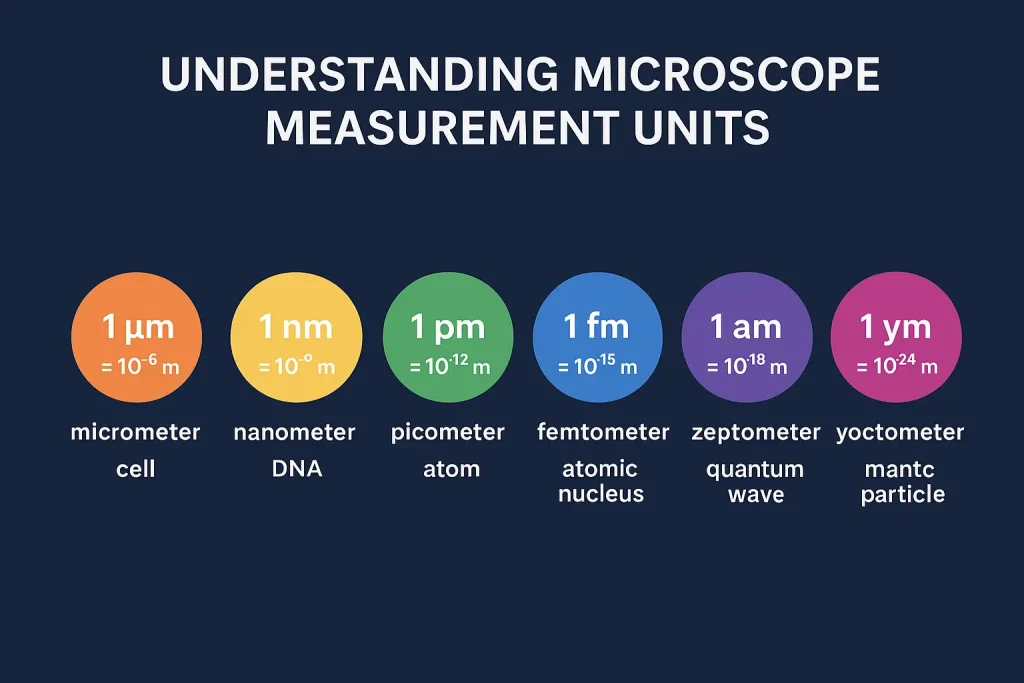
Understanding extremely small measurement units is essential in fields such as nanotechnology, physics, biology, and advanced materials science. Scientists use specific microscopic and subatomic units—such as the micrometer (µm), nanometer (nm), picometer (pm), femtometer (fm), attometer (am), zeptometer (zm) and yoctometer (ym)—to describe structures far beyond human visibility.
This article provides a complete, SEO-optimized guide to these scientific units, with definitions, real-world examples, and authoritative backlinks to support your understanding.
🌟 What Are Microscopic Measurement Units?
Microscopic units belong to the International System of Units (SI) and allow us to measure objects such as cells, molecules, atoms, and quantum-scale particles. These measurements are crucial in emerging sciences like nano-engineering, biophysics, semiconductor design, and quantum research.
For an official reference, consult the International Bureau of Weights and Measures (BIPM):
🔗 https://www.bipm.org
🔬 Main Microscopic Units (From Biggest to Smallest)
⭐ 1. Micrometer (µm)
- 1 µm = 10⁻⁶ meters
- Common scale: human cells (10–100 µm)
- Widely used in biology, microbiology and microscopy
More scientific context:
🔗 https://www.ncbi.nlm.nih.gov (National Center for Biotechnology Information)
⭐ 2. Nanometer (nm)
- 1 nm = 10⁻⁹ meters
- Scale of DNA, viruses, nanoparticles
- Essential in nanotechnology and semiconductor manufacturing
Learn more from the U.S. National Nanotechnology Initiative:
🔗 https://www.nano.gov/
⭐ 3. Picometer (pm)
- 1 pm = 10⁻¹² meters
- Commonly used to measure atoms
- Example: hydrogen atom radius ≈ 53 pm
Atomic structure reference:
🔗 https://www.chemguide.co.uk/atoms/properties/radii.html
⭐ 4. Femtometer (fm)
- 1 fm = 10⁻¹⁵ meters
- Used to measure nuclear particles (protons, neutrons)
- Known also as the fermi
Nuclear physics explanation:
🔗 https://www.britannica.com/science/nuclear-physics
⭐ 5. Attometer (am)
- 1 am = 10⁻¹⁸ meters
- Used in high-energy physics and theoretical particle sciences
Quantum science resource:
🔗 https://home.cern/
⭐ 6. Zeptometer (zm)
- 1 zm = 10⁻²¹ meters
- Represents ultrafast quantum phenomena
- Recently used to measure gamma-ray interactions at extremely tiny scales
Latest physics articles:
🔗 https://phys.org/physics-news/
⭐ 7. Yoctometer (ym)
- 1 ym = 10⁻²⁴ meters
- One of the smallest SI units
- Used mainly in advanced theoretical research on subatomic particles
More on SI units:
🔗 https://physics.nist.gov/
🧭 Comparison Table of Microscopic Units
| Unit | Symbol | Value (m) | Typical Use |
|---|---|---|---|
| Micrometer | µm | 10⁻⁶ | Cells, bacteria |
| Nanometer | nm | 10⁻⁹ | DNA, viruses, nanotech |
| Picometer | pm | 10⁻¹² | Atomic sizes |
| Femtometer | fm | 10⁻¹⁵ | Nuclei of atoms |
| Attometer | am | 10⁻¹⁸ | Subatomic physics |
| Zeptometer | zm | 10⁻²¹ | Quantum wave measurement |
| Yoctometer | ym | 10⁻²⁴ | Particle theory |
🔍 Why These Units Matter in Modern Science
These units help scientists:
- Explore and engineer nanomaterials
- Study cellular and molecular biology
- Understand atomic structure and quantum behavior
- Design semiconductors and micro-chips
- Develop quantum computers
- Conduct research in particle physics
For example, the semiconductor industry relies heavily on nanometers, while nuclear physics depends on femtometers.